

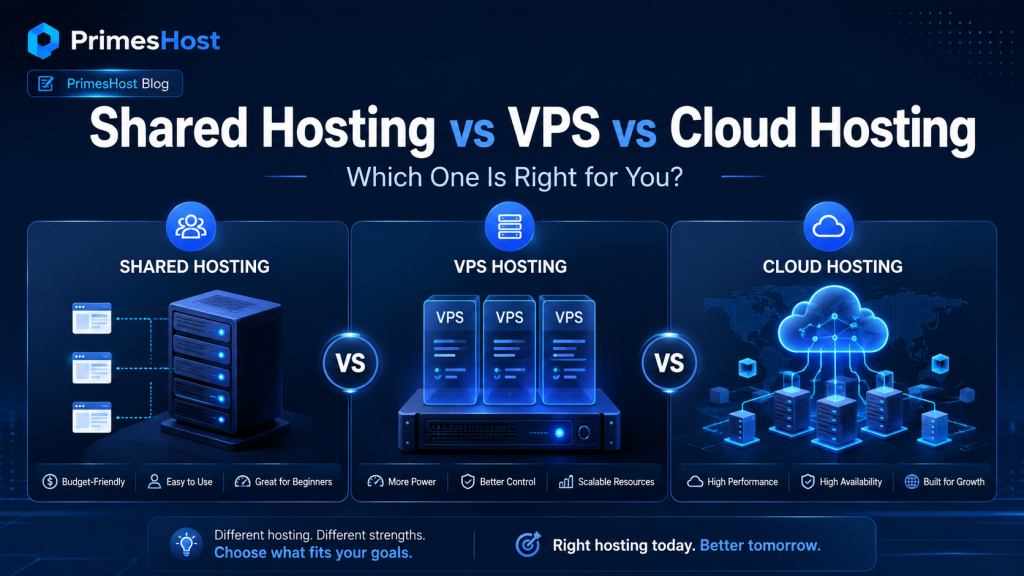
Choosing the right web hosting plan is one of the most important decisions when launching or growing a website. Your hosting affects your website’s speed, reliability, security, and ability to handle increasing traffic.
Three of the most popular hosting options are Shared Hosting, VPS Hosting, and Cloud Hosting. Each option is designed for different types of websites and business requirements.
What Is Shared Hosting?
Shared hosting is one of the most affordable and beginner-friendly hosting solutions. Multiple websites share the resources of a single server, including processing power, memory, and storage.
It is an excellent choice for:
- Personal websites
- Blogs
- Portfolio websites
- Startup websites
- Small business websites
Shared hosting is particularly useful for users who want to launch a website without dealing with complex server management.
With a reliable hosting provider, you can easily manage your website, email accounts, databases, domains, and files through a simple hosting control panel.
What Is VPS Hosting?
VPS stands for Virtual Private Server. A physical server is divided into several virtual servers, with each VPS receiving dedicated resources.
Compared with shared hosting, VPS hosting provides greater performance, flexibility, and control.
VPS hosting is ideal for:
- Growing business websites
- High-traffic websites
- Web applications
- Developers
- eCommerce stores
- Businesses requiring additional server resources
One of the biggest advantages of VPS hosting is the ability to customize your server environment according to your application’s requirements.
If your website has outgrown shared hosting but you are not ready for a complete dedicated server, VPS hosting can provide an excellent balance between performance and cost.
What Is Cloud Hosting?
Cloud hosting uses multiple connected servers instead of relying on a single physical server.
This architecture makes cloud hosting highly flexible and scalable. Resources can be adjusted as your website or application grows.
Cloud hosting is particularly useful for:
- Growing eCommerce websites
- SaaS applications
- Business applications
- High-traffic websites
- Development environments
- Websites with changing traffic requirements
Because cloud infrastructure is designed for scalability, businesses can expand their hosting resources without completely changing their hosting environment.
Shared Hosting vs VPS vs Cloud Hosting
The best hosting solution depends on your website’s requirements.
Choose Shared Hosting If:
You are launching a new website, blog, portfolio, or small business website and want an affordable hosting solution that is easy to manage.
Choose VPS Hosting If:
Your website requires dedicated resources, better performance, additional customization, or greater control over the server.
Choose Cloud Hosting If:
You expect your website or application to grow and need flexible resources, scalability, and reliable infrastructure.
Consider Your Website’s Future Growth
When choosing hosting, think beyond your current requirements.
A small website may work perfectly on shared hosting today, but as traffic, content, customers, and applications increase, additional server resources may eventually become necessary.
Choosing a hosting provider that offers multiple hosting solutions makes it easier to upgrade as your business grows.
Find the Right Hosting Solution with PrimesHost
PrimesHost provides hosting solutions for websites at different stages of growth, from shared hosting for beginners to powerful VPS, cloud, and dedicated server solutions.
Whether you are launching your first website or managing a growing online business, choosing the right hosting environment can help improve performance, reliability, and the overall experience for your visitors.
